Who Talks to Whom among Transnational Epistemic Elites Online?
Working Paper
The dominant theory of transnational expert coordination predicts that professional knowledge binds experts across borders — shared training and shared forums should matter more than passports. So who actually talks to whom among foreign-policy experts: does expertise drive the conversation, or nationality? I test this using 650,000 Twitter interactions among nearly 2,000 Turkish and American foreign-policy elites over a decade, modeled with relational event models. National identity wins decisively: the network splits along national lines, not institutional ones, even among academics and think-tank scholars who share professional training and forums — with American experts at the structural core and ruling elites as net consumers of knowledge production. I formalize these patterns as epistemic elite networks: expert formations that are transnational in reach but nationally segmented in structure, hierarchical, and porous rather than closed.
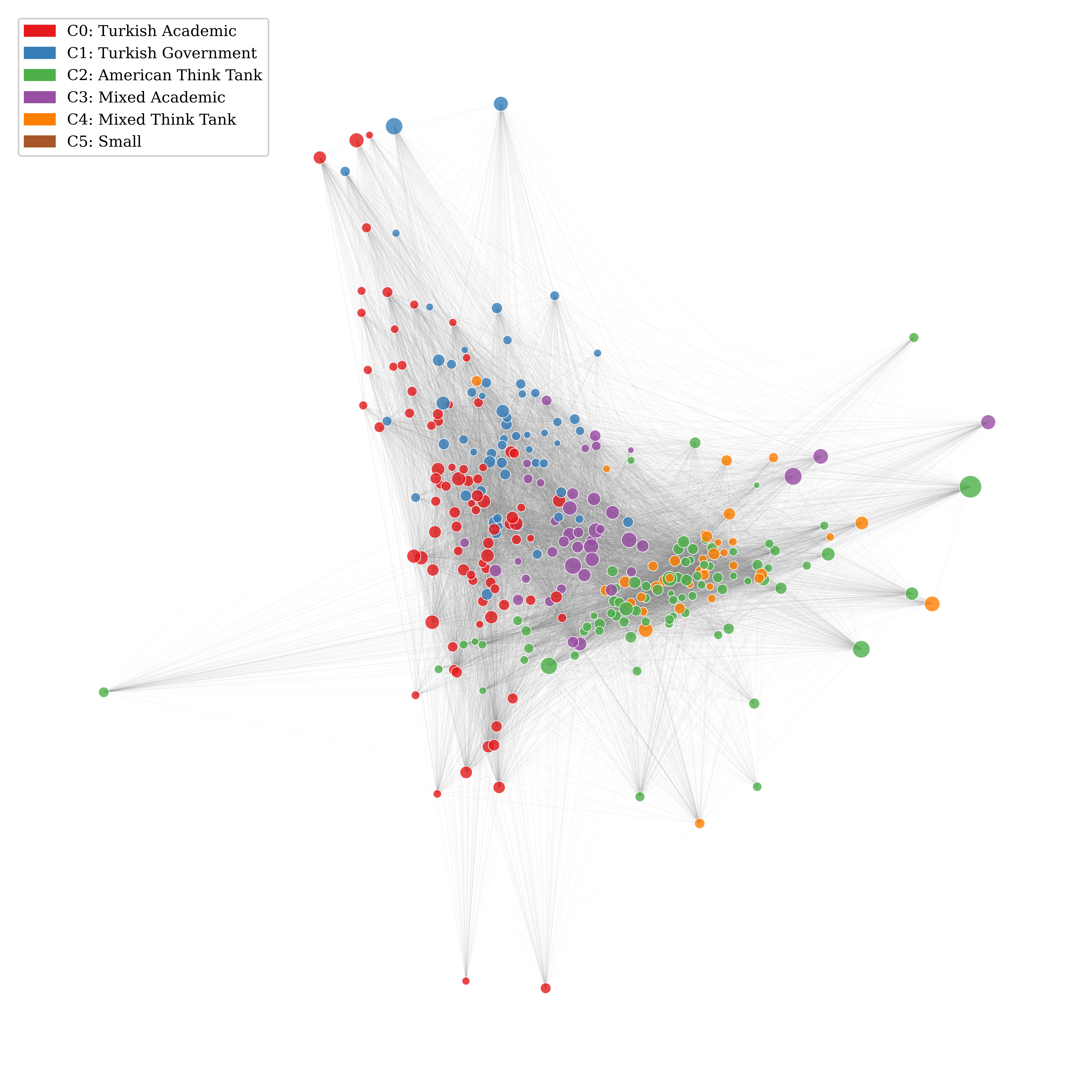
Figure: Network visualization of Turkish and American foreign policy elites, colored by community. The network splits along national lines rather than institutional ones.