What Drives Anti-Americanism in Turkish Social Media?
Working Paper
Yunus Emre Tapan (Northeastern University) · Tuba Ünlü Bilgiç (University of St. Thomas) · Zeynep Elif Koç (Atilim University)
Turkey has one of the lowest U.S. favorability ratings in the world — just 18% — yet how much anti-Americanism exists matters less than what kind it is: policy criticism rooted in sovereignty concerns can be addressed through diplomacy; entrenched prejudice attributing malevolence to American character cannot. So what is Turkish anti-Americanism actually made of, and how does its composition shift? We classify nearly 96,000 Turkish-language tweets across 13 years with LLM-based multilabel classification — validated against hand-coded ground truth, because we test the instrument before trusting the number — decomposing each message into theoretically grounded dimensions. The finding: anti-Americanism is overwhelmingly political — not religious, not cultural, not civilizational — but a substantial share of discourse pairs political substance with conspiratorial framing, a mechanism by which correctable opinion hardens into correction-resistant distrust. Different bilateral crises activate different signatures — conspiratorial spikes at the Gezi protests, religious ones at the Jerusalem recognition, economic ones at the 2018 lira crash — and conspiratorial framing keeps rising after 2020 even as political content holds steady. Anti-Americanism is not one thing but a shifting composite, and its composition determines whether diplomacy can reach it.
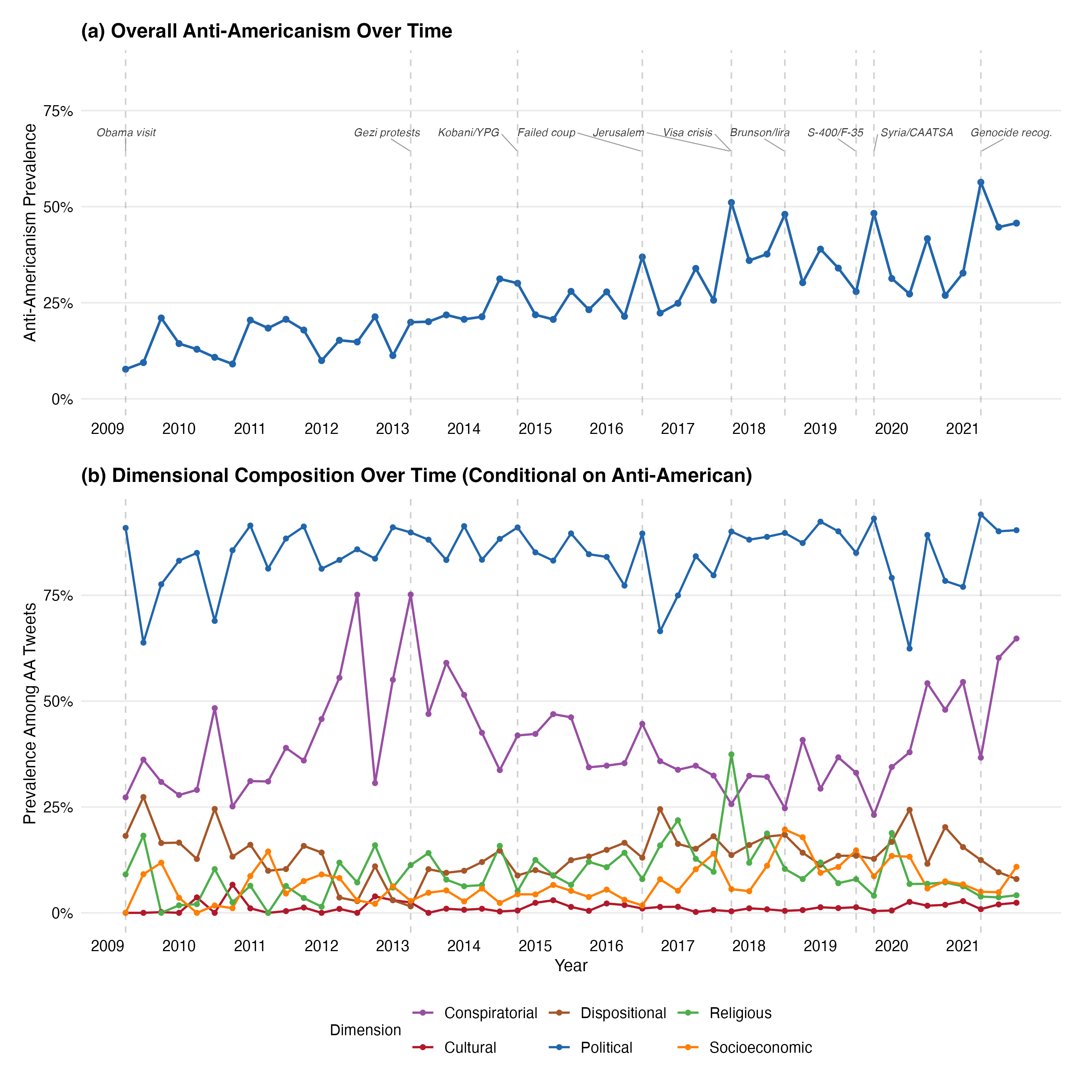
Figure: Dimensional signatures of anti-Americanism shift across bilateral crises — Gezi protests trigger conspiracy spikes, Jerusalem recognition triggers religious framing, and the 2018 lira crash triggers economic framing.