Anti-Americanism and anti-Westernism are usually studied one country at a time, as though each nation’s grievance were its own — yet strongmen across very different regimes seem to reach for a strikingly similar vocabulary. So do non-Western leaders construct anti-Western narratives the same way, and how does the framing vary across countries, themes, and time? This project extends the Anti-Americanism measurement framework from public tweets to elite speech, using LLM-based multi-label classification to decompose the rhetoric of three leaders — Narendra Modi, Recep Tayyip Erdoğan, and Vladimir Putin — into its constituent dimensions.
First findings. We labelled 189,163 passages from the 4,412 speeches in which the three leaders mention a foreign country, group or institution. Talk about national standing rarely comes with hostility: in about 92 of every 100 passages that claim standing for the country, or complain that it is denied, the leader criticizes no foreign actor. Criticism of the West does not stand out much either: compared with criticism of others, it brings up the country’s standing slightly more often for Erdoğan, about as often for Putin, and less often for Modi. Complaints about the West’s standing are also no more common in speeches at home than abroad.
The three also aim their complaints differently. Most of Erdoğan’s complaints point at foreign actors left unnamed. Putin’s complaints about the West and Ukraine rise sharply in 2022. Modi complains about foreign actors rarely, and China is criticized in only 36 passages across all three leaders. These are first results from automated labels, which we checked against five other language models.
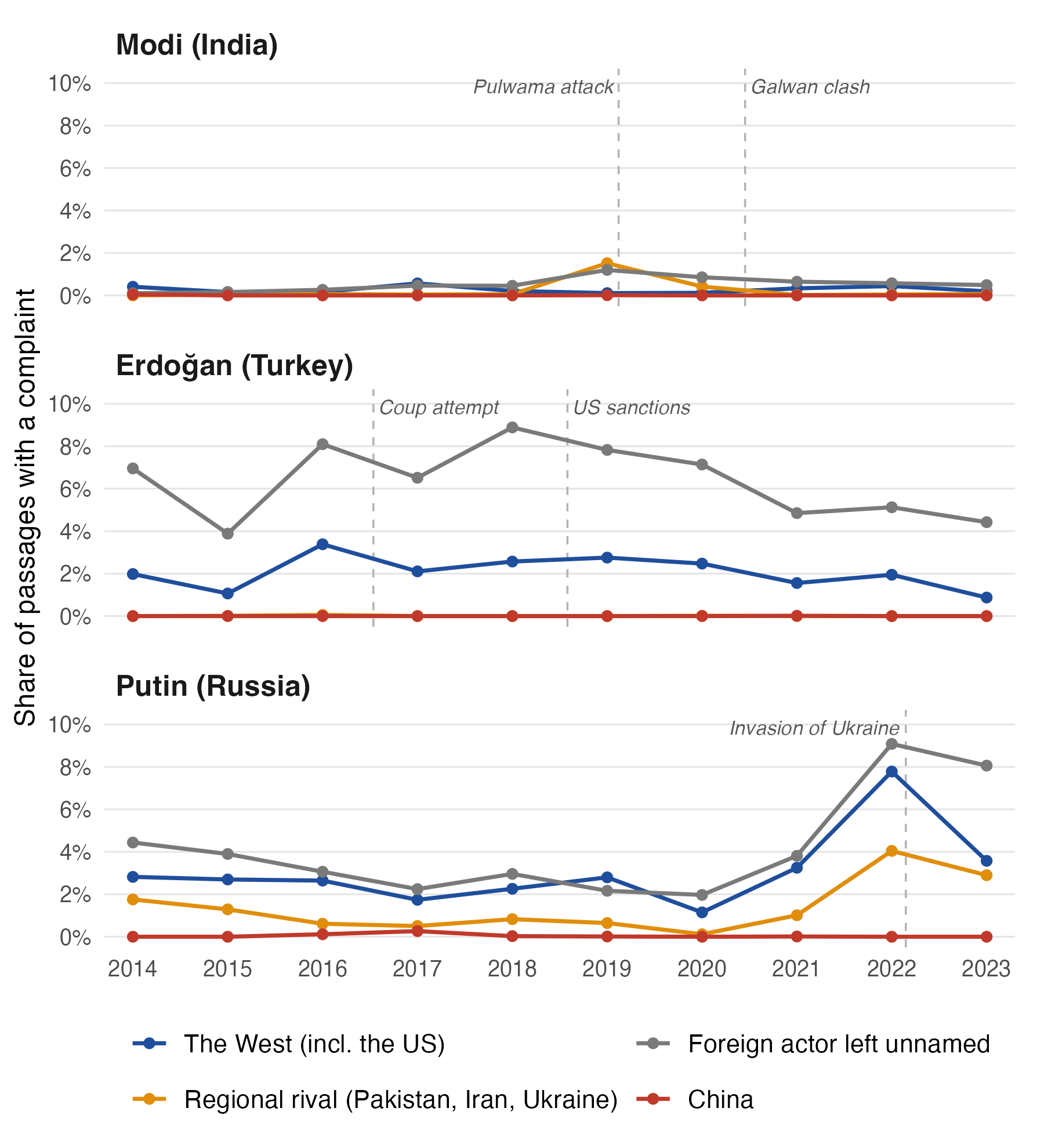
Figure: How often each leader complains about the West, the regional rival, foreign actors left unnamed and China, as a share of the passages labelled each year. 2014 starts in late August and 2023 ends in August.
More results, how sure we are of each, and the speech data behind them are on the project dashboard.